# pytorch-sepconv
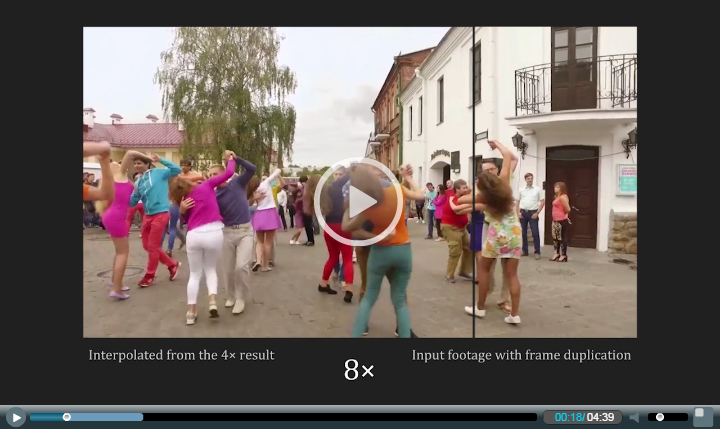
This is a reference implementation of Video Frame Interpolation via Adaptive Separable Convolution [1] using PyTorch. Given two frames, it will make use of adaptive convolution [2] in a separable manner to interpolate the intermediate frame. Should you be making use of our work, please cite our paper [1].
 For the Torch version of this work, please see: https://github.com/sniklaus/torch-sepconv
## setup
To build the implementation and download the pretrained networks, run `bash install.bash` and make sure that you configured the `CUDA_HOME` environment variable. After successfully completeing this step, run `python run.py` to test it. Should you receive an error message regarding an invalid device function during execution, configure the utilized CUDA architecture within `install.bash` to something your graphics card supports.
## usage
To run it on your own pair of frames, use the following command. You can either select the `l1` or the `lf` model, please see our paper for more details.
```
python run.py --model lf --first ./images/first.png --second ./images/second.png --out ./result.png
```
## video
For the Torch version of this work, please see: https://github.com/sniklaus/torch-sepconv
## setup
To build the implementation and download the pretrained networks, run `bash install.bash` and make sure that you configured the `CUDA_HOME` environment variable. After successfully completeing this step, run `python run.py` to test it. Should you receive an error message regarding an invalid device function during execution, configure the utilized CUDA architecture within `install.bash` to something your graphics card supports.
## usage
To run it on your own pair of frames, use the following command. You can either select the `l1` or the `lf` model, please see our paper for more details.
```
python run.py --model lf --first ./images/first.png --second ./images/second.png --out ./result.png
```
## video
 ## license
The provided implementation is strictly for academic purposes only. Should you be interested in using our intelectual property, please feel free to contact us.
## references
```
[1] @inproceedings{Niklaus_ICCV_2017,
author = {Simon Niklaus and Long Mai and Feng Liu},
title = {Video Frame Interpolation via Adaptive Separable Convolution},
booktitle = {IEEE International Conference on Computer Vision},
year = {2017}
}
```
```
[2] @inproceedings{Niklaus_CVPR_2017,
author = {Simon Niklaus and Long Mai and Feng Liu},
title = {Video Frame Interpolation via Adaptive Convolution},
booktitle = {IEEE Conference on Computer Vision and Pattern Recognition},
year = {2017}
}
```
## acknowledgment
This work was supported by NSF IIS-1321119. This video uses materials under a Creative Common license or with the owner's permission, as detailed at the end.
## license
The provided implementation is strictly for academic purposes only. Should you be interested in using our intelectual property, please feel free to contact us.
## references
```
[1] @inproceedings{Niklaus_ICCV_2017,
author = {Simon Niklaus and Long Mai and Feng Liu},
title = {Video Frame Interpolation via Adaptive Separable Convolution},
booktitle = {IEEE International Conference on Computer Vision},
year = {2017}
}
```
```
[2] @inproceedings{Niklaus_CVPR_2017,
author = {Simon Niklaus and Long Mai and Feng Liu},
title = {Video Frame Interpolation via Adaptive Convolution},
booktitle = {IEEE Conference on Computer Vision and Pattern Recognition},
year = {2017}
}
```
## acknowledgment
This work was supported by NSF IIS-1321119. This video uses materials under a Creative Common license or with the owner's permission, as detailed at the end.